
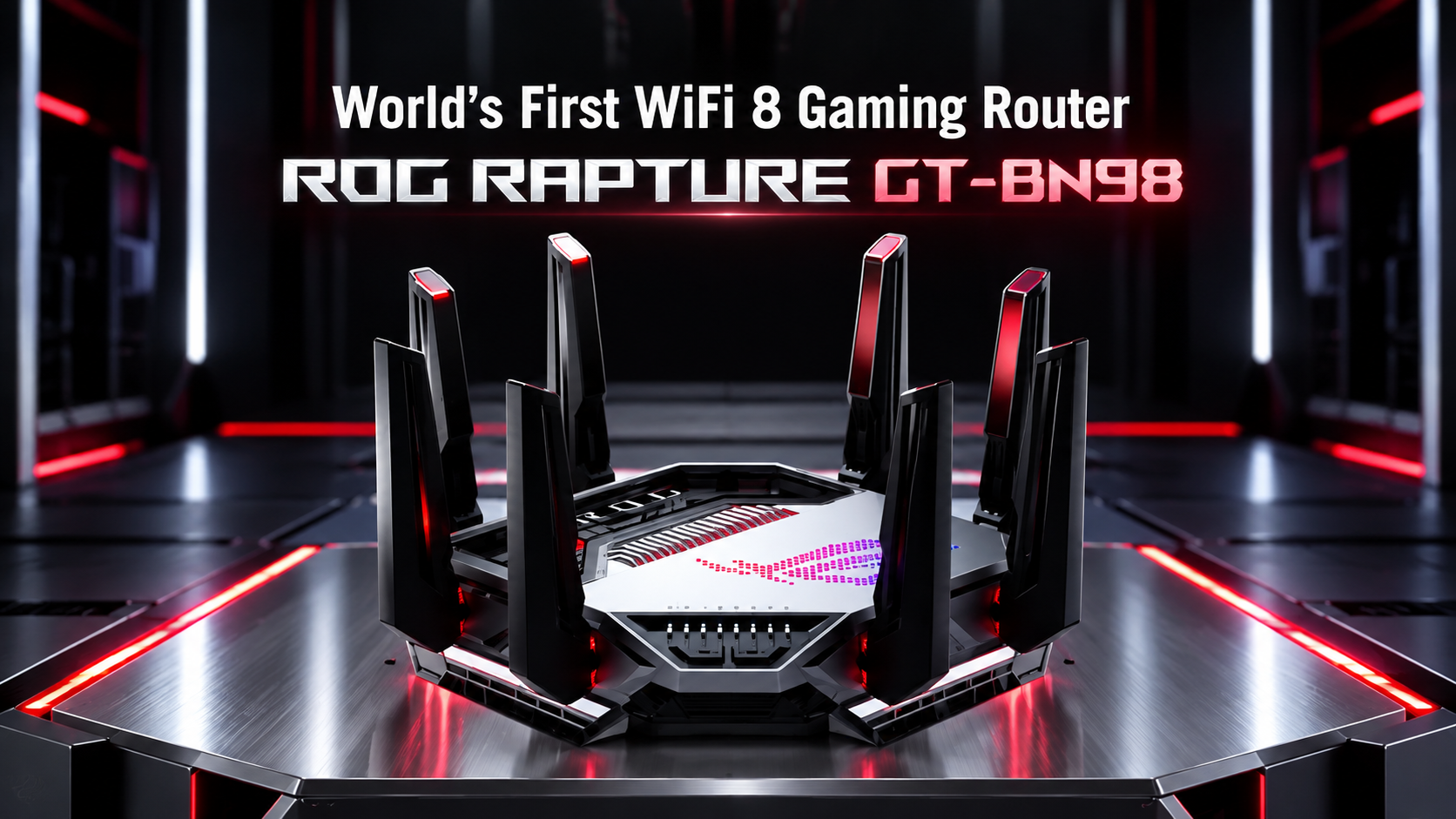

A premium gaming router with ambitious wireless features and extensive wired connectivity—but buyers should understand what its WiFi 8 label means today.
A router costing almost RM4,000 needs to offer more than an impressive number on the box. The ASUS ROG Rapture GT-BN98 is entering Malaysia with an announced suggested retail price of RM3,988, placing it firmly in enthusiast territory. Preorders are open, while ASUS has scheduled Malaysian availability for mid-October 2026.
For buyers, the interesting question is not simply whether this router is fast. It is whether the combination of wireless technology, wired connections and traffic-management tools addresses a problem their existing network cannot handle.
A household might have someone gaming, another person uploading video, and several devices streaming at the same time. That is the kind of scenario against which we would judge this router—not an isolated speed test beside its antennas.
WiFi 8: The Interesting Part Is Reliability
The GT-BN98’s headline feature is WiFi 8, but the technology’s ambitions extend beyond increasing peak speeds. The IEEE’s 802.11bn project focuses on ultra-high reliability, with objectives that include improving throughput under challenging conditions, reducing latency and lowering packet loss. These are development objectives, not guaranteed results for every product or household. IEEE 802
A connection that remains responsive during a busy evening could be more valuable than one that produces an impressive result only when nothing else is using the network. For our assessment, consistency would matter at least as much as maximum speed.
ASUS says its engineering tests have also shown performance improvements with existing WiFi 7 devices. Those are manufacturer findings, however, and should not be confused with independent measurements of this router in Malaysian homes. ASUS Global
The Important Catch: WiFi 8 Is Still a Draft Standard
Before treating this as a guaranteed long-term upgrade, there is an important qualification.
ASUS identifies the GT-BN98’s wireless standard as IEEE 802.11bn Draft. The IEEE task group’s published schedule projects final approval stages in 2028, meaning the underlying standard is still being developed.
ASUS also states that full use of WiFi 8 features requires compatible support from both the router and the connected device. Separately, its product disclaimer does not guarantee compatibility with future standards.
Our buying advice is therefore straightforward: evaluate the features available now, rather than assuming every future capability will arrive through a firmware update.
There is nothing inherently wrong with buying early-generation hardware. The important distinction is between paying for capabilities you can use and paying for expectations that have not yet been confirmed.
Quad-Band WiFi and 25,000Mbps: What the Numbers Actually Mean
The Malaysian GT-BN98 BN25000 is a quad-band router, using one 2.4GHz band, two 5GHz bands and one 6GHz band. ASUS markets its combined wireless rate at up to 25,000Mbps. It is not the dual-band, 30,000Mbps configuration described in the supplied article.
That headline number combines theoretical rates across the radios. It is not a promise that one phone will download at 25,000Mbps. ro
Nor does a faster router increase the speed of the internet package you subscribe to. ASUS’s own support guidance illustrates this distinction: a 300Mbps connection remains limited by that service even when connected through a much faster router port.
The useful question is therefore not, “Will everything become 25 times faster?” It is, “Which part of my current network is holding me back?”
That answer should come before the purchase.
The Wired Connections May Be the More Immediate Attraction
Inside the GT-BN98 is a 2.6GHz quad-core processor with 2GB of RAM. ASUS also describes a 16-antenna architecture integrated into eight external antennas, supported by a cooling design intended to maintain performance under sustained workloads.
The connections are particularly noteworthy. There are two 10Gbps Ethernet ports—one WAN/LAN and one LAN—alongside four 2.5Gbps ports, comprising one WAN/LAN and three LAN connections. A separate Gigabit LAN port is also included.
For someone planning a home studio or a network with several wired computers, this is arguably a more concrete starting point than the WiFi 8 branding.
Our assessment would begin with the intended setup: which devices will connect by cable, what speeds their network interfaces support, and whether large files regularly move between them. The router is only one part of that chain; ASUS’s troubleshooting guidance also highlights the importance of compatible network cards and cables.
For a creator handling video projects, those details deserve more attention than the appearance of the router itself.
Gaming Features With a Practical Purpose
ASUS includes Adaptive QoE, which adjusts bandwidth allocation according to network conditions and application demands. The bundled GTNet service is a third-party tool intended to optimise the route taken by gaming traffic.
The appeal is easy to understand: give important traffic appropriate priority when several activities compete for the connection.
However, we would judge these tools through repeatable testing. Does a game remain responsive while another device starts a large upload? Does enabling traffic management improve that situation without creating an unacceptable compromise elsewhere?
WiFi Insight adds interference monitoring and a 24-hour event history, while Guest Network Pro supports separate networks for different purposes. These could be useful for buyers who want greater visibility and control, rather than simply a replacement router with a newer wireless label.
For our money, understandable diagnostics would be an important part of the experience. A premium router should help its owner identify problems, not merely present more settings.
Malaysian Preorder Price and RM200 Steam Promotion
The GT-BN98’s announced Malaysian suggested retail price is RM3,988. ASUS’s preorder campaign also advertises a RM200 Steam code incentive.
The official campaign period runs from 25 September to 18 October 2026, with a separate final registration deadline of 31 October 2026.